Image Index
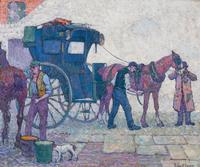
The Hansom Cab is a particularly refined example of Bevan’s urban horse paintings. Owned by family friends of Bevan since first purchase, and not seen in public for nearly seventy years, it demonstrates Bevan’s first-hand knowledge of the French avant-garde through his close contact with the Pont-Aven School in Brittany. Bevan had been allowed to give up the family banking business to study art in London and Paris and he spent time in Pont-Aven in the early 1890s.
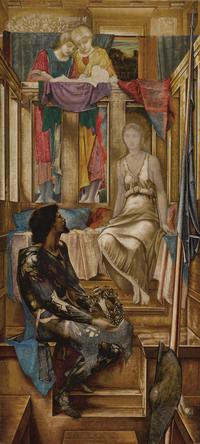
King Cophetua and the Beggar Maid is a smaller, experimental version of the oil painting that hangs in Tate Britain (1884) and the bodycolour, watercolour and pastel cartoon of the same subject in Birmingham Museums and Art Gallery (1883). A gouache and gum arabic picture (1883) of the same subject is in The Lord Lloyd-Webber Collection. According to a sixteenth century folk ballad, King Cophetua was an African King who, previously immune to female beauty, fell in love at first sight with a beggar maid.

Deverell’s Twelfth Night, painted when he was twenty-one, is undoubtedly his masterpiece. It is by far the largest of his few surviving paintings and was clearly intended to be a major statement and a bid for recognition. Everything about it betrays Deverell’s allegiance to the Pre-Raphaelite Brotherhood of which he remained one of their closest associates during the period. Deverell’s Twelfth Night is one of the last major early Pre-Raphaelite paintings to remain in private hands.
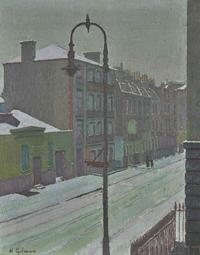
Gilman understood that the truly modern subject was the city, its back rooms and bed-sits and the quiet dignity of the isolated people who inhabited them. The perceived dislocation of his art may be seen in the painterly A London Street Scene in Snow which is almost completely disassociated from the urban sprawl and bustle. Always happiest with the static image, his cityscapes avoid the continual movement of the urban world.
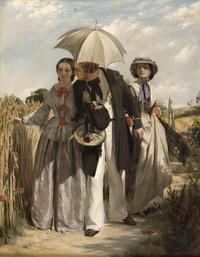
Mr Horsley’s naval lieutenant (H.M.S. Trifler) is “showing a preference” in a very indiscreet and decided manner. The very poppies hang their heads in shame.’ Punch (responding to the 1860 Royal Academy exhibit) In this work and others of his oeuvre, Horsley successfully depicts tight psychological narratives, incorporating figures who outwardly show a quiet, almost inscrutable, self-possession but whose internal thoughts are hinted at. Here, Horsley chooses a subject that serves as a metaphor for the shallowness of male romantic feelings, as the officer jilts one woman in preference for another.
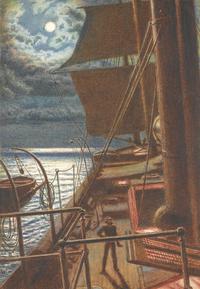
‘The moon makes for herself a clear path through clouds which crown, or rather encircle, her head with a halo of iridescent light. The sea beneath shines as burnished silver.’ The Art Journal Homeward Bound was painted in 1869 and sent to England in the autumn of the following year to be exhibited at the Old Watercolour Society, as the artist’s letter of 12 October to A.W. Hunt reveals: ‘I have lately sent home a couple of water colour drawings and I wish to give them to be mounted and framed to a safe man….
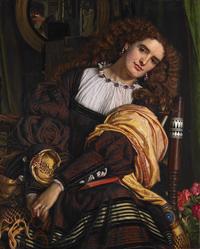
Begun in 1859, put aside and taken up again in 1865, and finally exhibited at the Royal Academy in 1867, this picture marked a radical departure for Hunt, as the title alone - with its Italian colloquial implication of ‘sweet idleness’ or ‘indolence’ indicates. No member of the Pre-Raphaelite Brotherhood had been more single-minded than Hunt in his determination to paint serious subjects replete with meaning and moral significance. His early works, if they had not been based on the Bible or Shakespeare, had at least had this ethical dimension, and in 1854 he had taken this approach to its logical conclusion by going to the Holy Land to paint biblical events on the very spot where they had occurred.
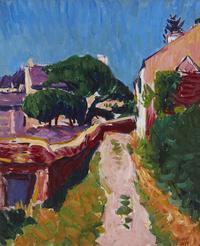
‘I like Brittany; here I find a savage, primitive quality. When my clogs echo on this granite ground, I hear the dull, muted, powerful sound I am looking for in painting.’ Paul Gauguin In 1895 O’Conor left the town of Pont-Aven in Finistère and moved his base further inland to the picturesque village and artists’ colony of Rochefort-en-terre in the Morbihan district of Brittany. Pont-Aven had become overrun with artists and tourists by this date, and O’Conor would have been charmed by the unspoilt character and colourful history of Rochefort with its twelfth-century church and fourteenth-century ruined castle.
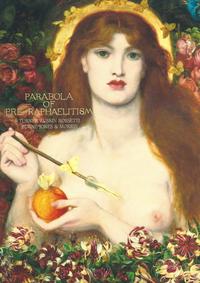
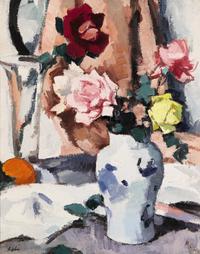
Through his still life painting, Samuel John Peploe experimented with the manipulation of colour and form. Working in his sun-drenched studio, the artist surrounded himself with potential subjects. As described by Elizabeth Cumming: ‘Flowers in season, roses following on from tulips, partner ceramic bowls or vases, set against a length of beautiful fabric (sometimes purchased from the Edinburgh furnishers Whytock & Reid), all so carefully selected, arranged and rearranged time and again before brush was ever put to canvas.
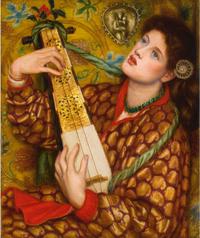
A Christmas Carol is one of Rossetti’s earliest of a series of half-length depictions of women playing musical instruments. The connection with female beauty, music and the fashion for exotic decoration and costume were central themes of the emerging English Aesthetic movement – the revolutionary artistic style of the 1860s and 1870s that combined elements of Renaissance, Oriental and Classical styles to create an époque that was to be as important in Britain as Art Nouveau was in Europe.

In Chatterboxes Steer utilised the same techniques employed by the French impressionists. He separated colour and even experimented with the radical effects of the neo-impressionists, believing that light would emanate from tiny touches of pure colour, fractured into small directional strokes that convey the sense of quietly rustling surfaces. He depicts the flickering sunshine in a French landscape and there is a sense of carefree, relaxation and joie de vivre in this evocative canvas showing the glowing faces of gossiping girls who are dressed in the same two-tone blue cotton that was in common use for ouvrière garments and school clothes throughout northern France.
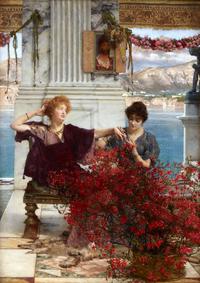
‘for the first-time classical genre subjects were represented with verisimilitude, learning and technical mastery.’ F. G. Stephens, ‘Alma-Tadema’, Artists at Home III This painting is typical of many of Alma-Tadema’s works from the latter part of his career. From the 1880s onwards his paintings were generally small-scale domestic scenes, illustrating either a minor incident or a moment of repose and contemplation. They are ambitious reconstructions of Rome frequently depicting its wealthy citizens at leisure.

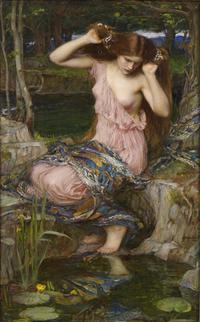
Having exhibited a painting of Lamia in 1905 (now in the Auckland Art Gallery) and made three additional treatments of the two-figure composition, Waterhouse sent to the Royal Academy’s 1909 Summer Exhibition this one-figure picture bearing the same title. In it the same young woman, arranges her hair alone while studying herself in the water’s reflection. Waterhouse had occasionally shown women with one or both breasts exposed, most notably in Echo and Narcissus (1903, Walker Art Gallery, Liverpool Museums).
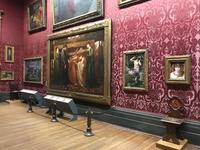
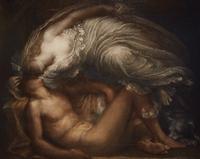
‘There is the most beautiful of all his pictures the Dream of Endymion…' Edward Coley Burne-Jones In Greek mythology, Selene (the goddess of the moon who was sometimes regarded as the personification of the moon itself), is known for her affair with the beautiful mortal Endymion, the young shepherd who used to sleep on a mountaintop, and with whom she had fifty daughters. In Roman mythology, Diana has the attributes of Selene and a similar myth tells of her falling in love with Endymion.
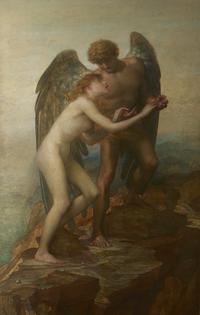
G. F. Watts is one of the most remarkable and versatile figures in Victorian art. During his long career of some seventy years, he made major contributions to history painting, the mural revival, portraiture, landscape, high Victorian classicism, symbolism, and the new sculpture. Watts, particularly with his more Symbolist paintings, dared to take risks and he ‘dragged English painting out of the eighteenth century and propelled it into the twentieth.’ (Jefferies.
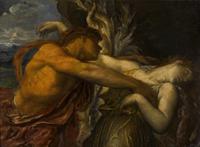
‘And now they were not far from the verge of the upper earth. He, enamoured, fearing lest she should flag and impatient to behold her, turned his eyes; and immediately she sank back again. She, hapless one! both stretching out her arms and struggling to be grasped and to grasp him, caught nothing but the fleeting air. And now, dying a second time, she did not at all complain of her husband; for why should she complain of being beloved?