Various Drawings
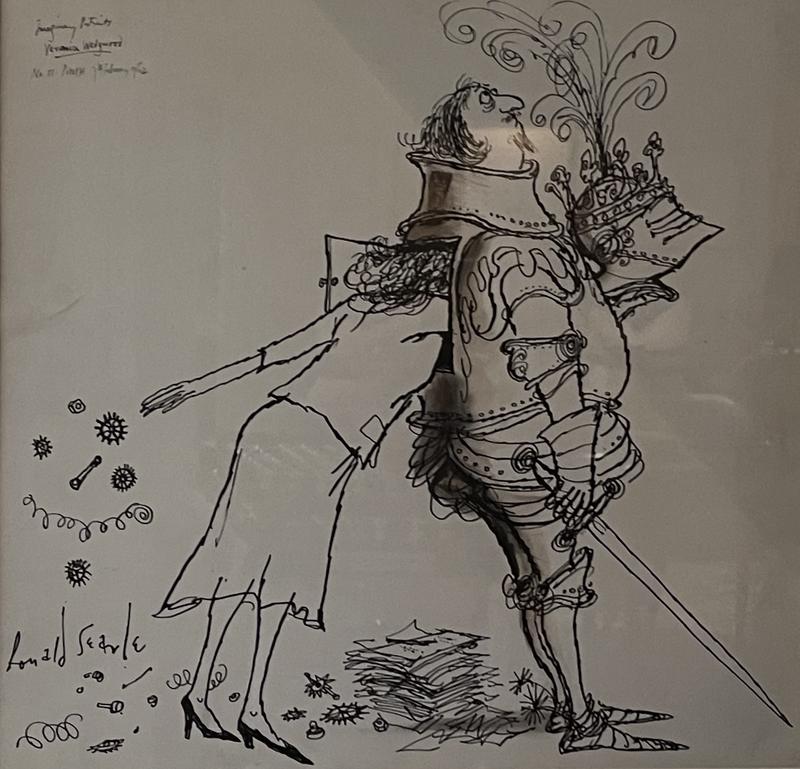
“The cartoonist, however inflected, inflated, or addicted, remains perfectly aware that he or she is nothing more than this week’s stand-up comic battling as always for attention, just reward, a better place on the playbill, full copyright, and the hearts of a public who have paid to be diverted in the old music-hall tradition in which comic drawing was born.” - Ronald Searle
Ronald Searle’s artistic career was one of the longest and most varied in British illustration history, spanning more than seven decades.
His professional life began at fifteen, when he started contributing cartoons to the Cambridge Daily News. His first St Trinian’s cartoon, depicting the anarchic girls of a fictional boarding school, was published in the magazine Lilliput in October 1941.
Searle was profoundly influenced by his experience as a Japanese prisoner of war during World War II. Denied proper materials, he devised ways to create his own ink, including using dyes meant for staining microscope slides. Searle himself said of the experience: “It all made me into an artist, though. I went into the war as an art student of 19, who did pictures of my mum and dad and the dog. Suddenly you’re drawing people who are going to die.”
After liberation, his career accelerated rapidly. He published his first book of cartoons, Hurrah for St Trinian’s and Other Lapses, in 1948, and continued putting out new material until 2011. He expanded his work by undertaking theatre reviews and supplying caricatures and illustration for Punch, which had begun publishing his cartoons in 1946, continuing that relationship until 1960.
In the 1950s, Searle developed his widely imitated trademark style, holding the middle ground between loose, cartoony drawings and more realistic observational work. His characters, tall and spindly, with hilariously expressive faces, were unlike anything else in British illustration. His cartoons didn’t always revolve around a clear gag, but were mostly witty interpretations of people, animals, and life in general.
He reached an international audience in the 1950s and 1960s, with his cartoons syndicated around the world. In the United States he worked for Holiday, Life, Look, TV Guide, The New York Times, and The Saturday Evening Post, among others. He began submitting to The New Yorker around 1970, drawing cartoons, special assignments, and nearly forty covers, working for them well into the 1990s.
His collaboration with writer Geoffrey Willans on the Molesworth books, four comic novels narrated by a hapless schoolboy gave Searle a second iconic creation alongside St Trinian’s and showcased his gift for character and comic timing in illustration. Later in his career his cartoons had less clear punchlines, with the artwork itself becoming the real joke, elaborate, detailed drawings that rewarded close attention. These experiments evolved into a more extreme style full of blobs, dribbles, slashes, and angles.
Moving to Paris in 1961, and later to rural Provence in 1975, Searle reinvented himself again. Projects included designs for commemorative medals for the French Mint, advertisements for American Express and Lloyds Bank, and many covers and cartoons for The New Yorker. Notable books included Ronald Searle’s Big Fat Cat Book (1982), The Illustrated Winespeak (1983), and Slightly Foxed- But Still Desirable (1989). He was also the first non-French living artist to exhibit at the Bibliothèque Nationale in Paris.
His influence on the development of satirical and political cartooning in Britain was profound, touching many developing artists of the later twentieth century and beyond most significantly Gerald Scarfe and Ralph Steadman, in whose scratchy, ink-splotting styles the debt to Searle is undeniable. Matt Groening, Pat Oliphant and Edward Gorey, all cited him as a key influence. Few cartoonists have left so indelible a mark on so many.