Battle of the Nile
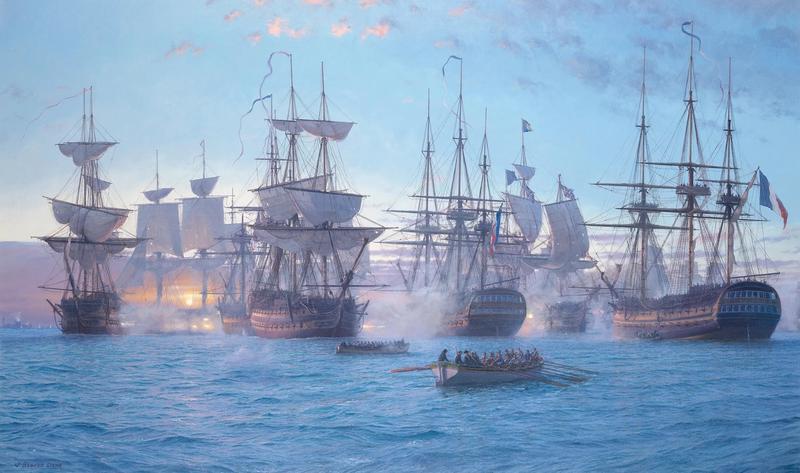
Firing began at twenty-eight minutes past six on the evening of 1 August 1798, when Captain Foley in Goliath rounded the head of the French line at Aboukir and crossed inshore of the leading enemy ship. Within half an hour, the British van had passed between Brueys’s anchored fleet and the shoals while a second division engaged from seaward; by seven, the smoke was thick enough that the British ships hoisted white lamps at the mizzen peak to distinguish friend from foe. None of this did Dews see. Working in his studio more than two centuries on, from Admiralty draughts, the memoirs of Nelson’s captains and a lifetime under sail, he has reconstructed the half-hour at which the battle was decided: the sun still low between the second and third ships from the left, the smoke just beginning to rise from the lower gun-decks, the topgallants still set on several of the engaged vessels. A few minutes later, and the action would have passed beyond his reach into the dark of the Egyptian night, and into the fire that would consume the French flagship at five minutes past ten.
John Steven Dews was born in Beverley in 1949 to a Humber family of three generations at sea: his grandfather was Assistant Harbour Master at the Hull Docks, and the artist dates his interest in shipping to the boyhood Saturdays spent there. After failing his Art A Level, he was admitted, on portfolio, to Hull Regional College of Art, where he read for a degree in Technical Graphics and Illustration; on graduation, he set up a studio in a derelict farmhouse on the north bank of the Humber Estuary and began the long pencil discipline on which his finished oils still rest. His first one-man exhibition, mounted in 1976, sold out on opening night and brought seventeen further commissions; a second, in San Francisco the following year, established the transatlantic market he has worked in since. He works principally between studios in the United Kingdom and Australasia and takes commissions several years in advance.
Dews stands at the head of the British marine school, and so at the end of a tradition more than three centuries old. When Willem van de Velde the Elder and his son took up a studio at the Queen’s House at Greenwich in 1672, on a pension from Charles II, they brought the Dutch capacity for battle composition and the practice of the working drawing made under fire. The eighteenth century elaborated the inheritance: Samuel Scott into the action piece, Nicholas Pocock, a near-contemporary of the Nile and an officer of the merchant marine before he took up the brush, into the engagement seen from the deck, Thomas Whitcombe into the panoramic record. The nineteenth century carried it through Edward William Cooke to William Lionel Wyllie at the cusp of sail and steam, and Montague Dawson brought it into the twentieth. Dews’s contribution is to have taken the Pocock and Whitcombe register, the engagement now of decision, and renewed it in a photographic age, with the discipline of a yachtsman who knows from his own deck how a square-rigger handles a light easterly at dusk.
The composition is built upon four ships of the line drawn across the upper two-thirds of the canvas, the foreground given to the Vessels and the water between the battle and the viewer. From the left, an English seventy-four shows her port quarter against the setting sun, her white ensign at the gaff and only her topsails set. Behind her, half-veiled in smoke, lies a second British ship. The third, almost central, is the largest in the picture: a French two-decker, her tricolour at the mizzen, her larboard broadside opening in a bank of orange flame and brown smoke. To her right, a British ship of the line carries the Red Ensign at her gaff and the Union at the foretopmast head, port lids triced up, and main yards braced sharp. A second French two-decker, larger again, her tricolour streaming almost to the picture’s edge, closes the right. Two ships’ boats, one carrying an officer in a dark coat and a cocked hat, ride out the engagement in the deeper green water of the bay.
The atmospheric handling is the picture’s principal achievement and depends on a single calibrated decision: to keep the sky cool while letting the warmth of the gunfire rise through the smoke. The cirrus is laid in long strokes of pale rose against a high celadon, the lower clouds catching the salmon and apricot of late-summer dusk over the eastern Mediterranean; the sea is rendered in the cool greens and slate blues of deeper water, modulated to a thin cerulean where the surface catches the upper light. Against this contrast, the muzzle flashes read as small orange detonations in a mostly blue picture, and the dirty rose of gunpowder smoke (eighteenth-century black powder produced a smoke pinker than later cordite, a detail period battle painting rarely records) veils the lower hulls without obscuring the shipwork above. It is the atmospherics of which Wyllie would have approved.
The picture is also, in the precise sense, a piece of naval history. That Foley took Goliath inshore was a private decision, made on the observation that the French anchor cables were rigged to seaward only, the larboard side undefended. The doubling that followed was not a pre-planned envelopment but an opportunistic reading of the French dispositions, and it is the manoeuvre Dews has caught at its critical moment: van inshore, centre coming up to seaward, the French line about to be taken in crossfire. Of the thirteen French ships of the line, eleven were destroyed or taken; of nearly nine thousand men, some five thousand two hundred were killed, drowned or captured, against fewer than nine hundred British casualties.
With Bonaparte and the Army of the Orient stranded in Egypt, British naval ascendancy helped bring Russia, Austria and the Ottoman court into the Second Coalition. Nelson, surveying the bay at first light on 2 August, wrote that victory was not a name strong enough for such a scene; he was elevated to the peerage as Baron Nelson of the Nile that November. The action began the campaign that would close at Trafalgar.
Battle subjects are rare in Dews’s mature output, which has run of late to the racing yachts of the Solent and the clippers of the China and Cape trades; the engagements of the Revolutionary and Napoleonic Wars are a category he has returned to only at intervals, and on commission. To paint the action in its decisive half-hour, with the sun still visible above the horizon and the smoke not yet risen above the upper rigging, is to attempt a moment that earlier painters of the subject (Pocock, Whitcombe, Arnald) have generally avoided in favour of the explosion of L’Orient at ten: the explosion is what the eye remembers, the half-hour before it is what the historian must reconstruct. That Dews has caught the earlier and harder hour, two centuries on, and held it within an unforced register, places the picture among the most considered of his recent historical canvases.