Summer in the Fields
Exhibition
Munich, Secession (catalogue untraced)On 19 October 1945, eleven months after George Clausen’s death at Cold Ash, the contents of his studio were dispersed at Christie’s. Among the canvases gathered up from forty years of working life was a picture which had never been entered in the account books, had not been sent to an English exhibition under its present title, and had never been sold. It went as lot 136, catalogued simply as ‘Summer in the Fields’. McConkey has since proposed that it was begun in 1898 and not fully resolved when the artist set it aside; the surface itself confirms more than one campaign of work. That a canvas of this scale and ambition should have remained on the easel for very nearly half a century is the first key to its character. It was, in the precise sense, a private picture, and a laboratory for the Impressionist handling that would carry Clausen into the new century.
By the closing years of the 1890s, Clausen’s manner was being noticed for its richness and variety of palette, for its readiness to find colour in shadow, and for the visual excitement of complementary contrasts. In the landscape compositions of these years, he favoured an aerial viewpoint, locating his foreground figures upon a plane that carries the eye through middle distance to the horizon, and reserving the upper third of the canvas for a windswept sky of scudding cloud. Summer in the Fields is the first of a sequence of such canvases, in which Clausen returns to questions he had first set himself as a young painter under the spell of Bastien-Lepage. From it, he moved quickly into the larger compositions of labouring gangs, Sons of the Soil, 1901 (Private Collection), Harvest, Tying the Sheaves, 1902 (private Collection), and Harvest: In the Beanfield, 1904 (Durban Art Gallery), in each of which figures are contained within a clearly defined foreground space surveyed from above, with figures and setting given equal weight.
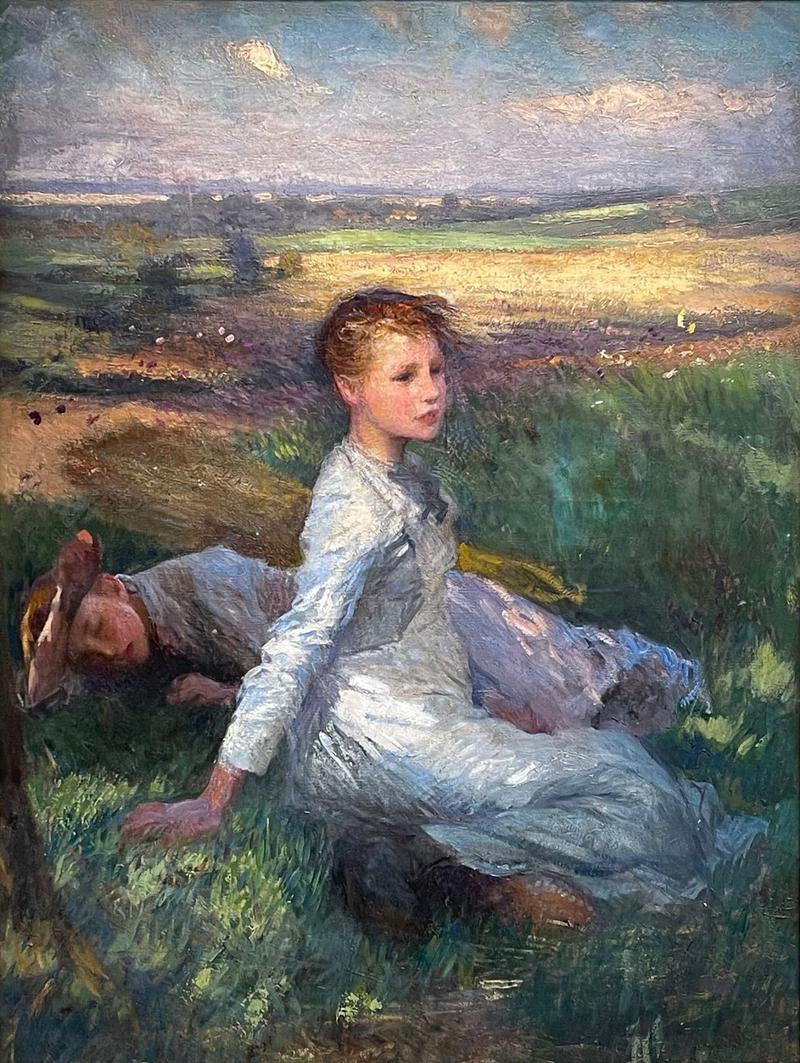
The point of departure was a French one. Bastien-Lepage and Léon L’Hermitte, unlike their Barbizon predecessors, took a high vantage upon the labour of the field, sacrificing none of the circumstantial detail. The picture that was used to make the case for English audiences was Bastien’s Les Foins, 1877 (Musée d’Orsay, Paris), shown at the Grosvenor Gallery in the summer of 1880, where Clausen studied it closely. Bastien shows a young woman seated foursquare, exhausted and absorbed, while her male companion sleeps to the rear with his hat over his face. Clausen takes the same compositional couple and turns it upon its axis: two young haymakers, one alert before us, the other asleep to the rear, a hat tilted across the sleeping face. The exchange of sex is part of the meaning. Where Les Foins is a picture of fatigue and social pressure, Clausen’s is lyrical, almost airborne: the principal figure straightens her back against a stiff breeze, as though roused by a distant call, the painter at this period being taken up with the theme of lark-song. The canvas has the quality of arrested listening.
The seated girl, in a pale cream blouse and skirt, sits upright at the front of the field, her right hand planted in the grass to her side, taking her weight, her left resting against her hip. Her hair, the warm copper-red Clausen reserved for his Essex models, is lifted by the wind, and the light catches the side of her brow and the line of her jaw. Her companion is half-fallen on the grass to the rear, in profile, a yellow straw hat pushed down to shadow the eyes. Beyond them, a strip of bare earth scattered with flecks of pink and violet wildflower marks the edge of the worked field; a band of cut hay catches the sun in a horizontal of warm gold; and beyond, the green of summer pasture, distant hedgerows, a single tree, and a high silvery sky in which the cloud has been worked up with the palette knife. The face of the principal figure is thrown into relief by surrounding touches of mauve and viridian, as one field overlaps another in the middle distance.
The country is identifiable. Clausen had moved to Widdington, in north-west Essex, in 1891, and the long view across to the rising ground beyond the hayfield is drawn from the country around Tilty and Clavering, within easy walking distance of his house and his separate studio. He had taken Widdington precisely for the access it gave him to a working agricultural landscape, and for the cooler, more silvery northern light that distinguished it from the midland Hertfordshire of Childwick Green. Small dabs of colour set against the swift, scratched strokes of sunlit grass produce the optical shimmer of summer heat; in the upper register, the paint loads the cloud with a heavy creamy pigment that throws the figures into relief beneath. Colour and handling of this kind place the picture in the immediate company of Rest, 1896 (Queensland Art Gallery, Brisbane) and The End of a Long Day, 1898 (Art Gallery of Western Australia, Perth).
The genesis of the composition can be reconstructed in some detail. Summer in the Fields does not appear in the artist’s account books, although the gap in his record-keeping between September 1896 and October 1897 may explain the silence; it is also possible that the picture was originally known under a different title. An independent oil of the sleeping girl passed through the Fine Art Society at the end of the 1980s. An unfinished drawing of the seated figure is in the Royal Academy collection; the Victoria and Albert Museum hold a more finished study of the same figure, together with a drawing of the ensemble (E.1941–1946); and the Holburne Museum, Bath, has a further head study. The studies confirm that Clausen carried the principal figure through the customary cycle of preparatory work he had established for the major Widdington canvases, with the head and pose worked up independently before the figure was placed in the field.
The composition belongs to a long lineage of resting figures in Clausen’s practice, from Day Dreams and Labourers After Dinner of the early Cookham Dean period, by way of the watercolour Idleness of 1891, to Evening Song, exhibited at the Royal Academy in 1893, and the great hayfield picture Noon in the Hayfield, 1897–8 (Private Collection), in which he had revisited the theme of the resting child after an interval of seven seasons. Summer in the Fields shares the warm palette and the disciplined high-key tonality of the earlier pictures and also Clausen’s wish to translate into oil the chromatic effects he had already obtained in pastel, but it goes further, dissolving the firm Naturalist contour into a freer, more atmospheric facture. The painter is plainly less preoccupied with surface detail than formerly. He is making the case here for an English picture that honours the documentary truthfulness of Bastien and L’Hermitte while refusing the mood of fatigue, and that gives equal value to figures, field, and weather.
By the late 1890s Clausen and his contemporaries were no longer content to be read as followers of a French fashion. They were developing a recognisably English variant of modern painting, alert to international developments and rooted in a particular country, in particular weather, and in the speech and faces of particular models. The presence of Summer in the Fields at the Munich Secession, the leading German forum for moderately progressive painting outside the academy, gives a measure of the standing British Impressionism had earned by the closing years of the century. That the canvas remained on the easel is testimony to something else: a picture to which Clausen returned more than once and which he was finally content to keep. Its emergence at the studio sale in 1945, its passage at Christie’s in November 2004, and its place among the most considered statements of his transition into the new manner.
We are grateful to Professor Kenneth McConkey for his assistance and contributions to this essay.